
The Second Shadow War (2260–2261) was the climactic struggle between the Shadow Alliance and the united younger races, with the Vorlon Empire returning as both ally and growing threat. Fought in the shadows and in open space, the war ended not with the total destruction of one side, but with the departure of all First Ones — leaving the younger races to decide their own future.
Event Overview
- Name: Second Shadow War (often simply “The Shadow War”)
- Date: Primarily 2260–2261 CE (with build-up beginning in 2258–2259)
- Primary Adversaries:
- Shadow Alliance and Shadow-aligned powers (including the Drakh and manipulated states such as the Centauri Republic in certain operations)
- A coalition of younger races led from Babylon 5, with decisive support from the Minbari Federation, Narn Regime, League worlds, and eventually the Vorlon Empire
- Primary Theaters: Regions around Z’ha’dum, League and border space, routes around Babylon 5, and later multi-front campaigns across known space
- Outcome: Shadows and Vorlons withdraw “beyond the Rim”; younger races form the Interstellar Alliance
The Second Shadow War marks the end of an age: the final time the First Ones openly shaped the fate of the younger species.
Background & Build-Up
The road to open war began quietly:
- Shadow Reawakening:
- The Shadows stirred from their long hibernation on Z’ha’dum, reactivating dormant agents and sleeper networks.
- They resumed their old strategy: spreading chaos, arming chosen pawns, and asking leaders the fateful question, “What do you want?”
- Proxy Conflicts:
- Wars such as the Narn–Centauri War were fueled by Shadow support and technology, destabilizing the region and weakening potential opposition.
- Babylon 5 as Nexus:
- Babylon 5 became a nerve center for diplomacy and intelligence — and a prime target for both Vorlon and Shadow attention.
- Figures like John Sheridan, Delenn, Kosh Naranek, and Londo Mollari were drawn into the deeper conflict, often without understanding the full stakes at first.
By 2260, the Shadows began moving from covert manipulation to open attacks on shipping lanes, border systems, and strategic worlds.
Escalation to Open War
Shadow Offensives
- Shadow fleets struck rapidly and without warning, annihilating fleets and colonies that stood in their way or refused their offers.
- Their allies — including certain Centauri elements, rogue organizations, and minor powers — exploited the chaos for territorial and political gains.
Formation of the “Army of Light”
- In response, Sheridan and Delenn forged a multi-race coalition informally known as the Army of Light.
- Key components included:
- White Star Fleet: Hybrid Minbari/Vorlon-influenced ships designed specifically for fast, hard-hitting operations against Shadow vessels.
- Rangers (Anla’Shok): Reconnaissance, intelligence, and special operations assets operating across many borders.
- Fleets from Minbari, Narn, and League races willing to commit to open resistance.
As the White Stars scored early victories and began freeing worlds from Shadow influence, the war shifted from desperate defense to active counter-offensive.
Vorlon Intervention & Escalation
The entrance of the Vorlons changed the war’s tone dramatically.
- Vorlon Counter-Campaign:
- Vorlon fleets began targeting worlds believed to be contaminated by Shadow influence — not just military bases, but entire planets.
- They sterilized or devastated these worlds, killing countless innocents in the name of preventing future Shadow manipulation.
- Twin Extermination Campaigns:
- Shadows responded by stepping up their own attacks on Vorlon-aligned worlds and races.
- The galaxy effectively became the battleground for a long-simmering First One ideological war — with younger races caught in the middle.
Sheridan and Delenn realized that unless stopped, both sides would destroy world after world in an attempt to “win” their ancient argument.


Key Battles & Turning Points
- Shadow Attack on Babylon 5:
- In late 2260, the Shadows launched an open assault on Babylon 5 while Sheridan was lured to Z’ha’dum.
- The station, with support from allied ships, fought off the attack, but the battle underscored Babylon 5’s centrality to the war.
- Z’ha’dum & Sheridan’s “Death”:
- Sheridan traveled to Z’ha’dum, confronted the Shadows, and triggered a massive explosion using nuclear devices, falling into the abyss as the city was engulfed.
- Thought dead by many, he later returned with new insight into Lorien, the First of the First Ones, and the true nature of the conflict.
- Final Campaign & Battle of Coriana VI:
- The Army of Light gathered an enormous coalition fleet at Coriana VI, hoping to force a decisive end to the war.
- Vorlon and Shadow fleets converged, prepared to annihilate each other — and potentially the entire system — while continuing to use younger races as proof points in their ideological arguments.
At Coriana VI, the conflict reached its philosophical and military climax.
Resolution: Departure of the First Ones
In the confrontation at Coriana VI:
- The Argument Laid Bare:
- Vorlons and Shadows each demanded allegiance and proof that their way — order vs. chaos, guidance vs. struggle — should define the future.
- Sheridan, Delenn, and representatives of the younger races refused the premise of the question itself.
- Rejection of the “Parents”:
- The younger races declared that they would no longer be pawns in an ancient debate.
- With Lorien’s help, they forced both Vorlons and Shadows to see that their “children” had grown beyond the need for such guardianship.
- Beyond the Rim:
- The Shadows, Vorlons, and remaining First Ones agreed (or were compelled) to withdraw from the galaxy, traveling “beyond the Rim” — into realms unknown.
The war ended not with victory in the traditional sense, but with freedom: the end of direct First One control.
Aftermath & Consequences
The Second Shadow War’s aftermath reshaped everything that followed:
- Power Vacuum:
- With the First Ones gone, no ancient power remained to intervene against rising threats such as the Drakh.
- Birth of the Interstellar Alliance:
- Recognizing the need for collective security and shared responsibility, the victorious younger races formed the Interstellar Alliance.
- Babylon 5 and Minbar became central hubs for this new order.
- Psychological Shift:
- Many cultures had to re-interpret religious myths and prophecies built around Vorlon and Shadow imagery.
- A new story emerged: not of gods and demons, but of mortals who chose their own path.
In unified lore, the Second Shadow War marks the Second Great Turning — the moment when the younger races stepped fully into their own age.
Legacy
The Second Shadow War is remembered as:
- The final act in a conflict stretching back hundreds of thousands, perhaps millions, of years.
- The moment when the younger races rejected both enforced order and manufactured chaos.
- The birth cry of the Third Age of Mankind and the broader era of the Interstellar Alliance.
Compared to earlier cycles, this war ended differently: not with one ancient side triumphant, but with all of them gone — leaving the galaxy to those who would live in it.
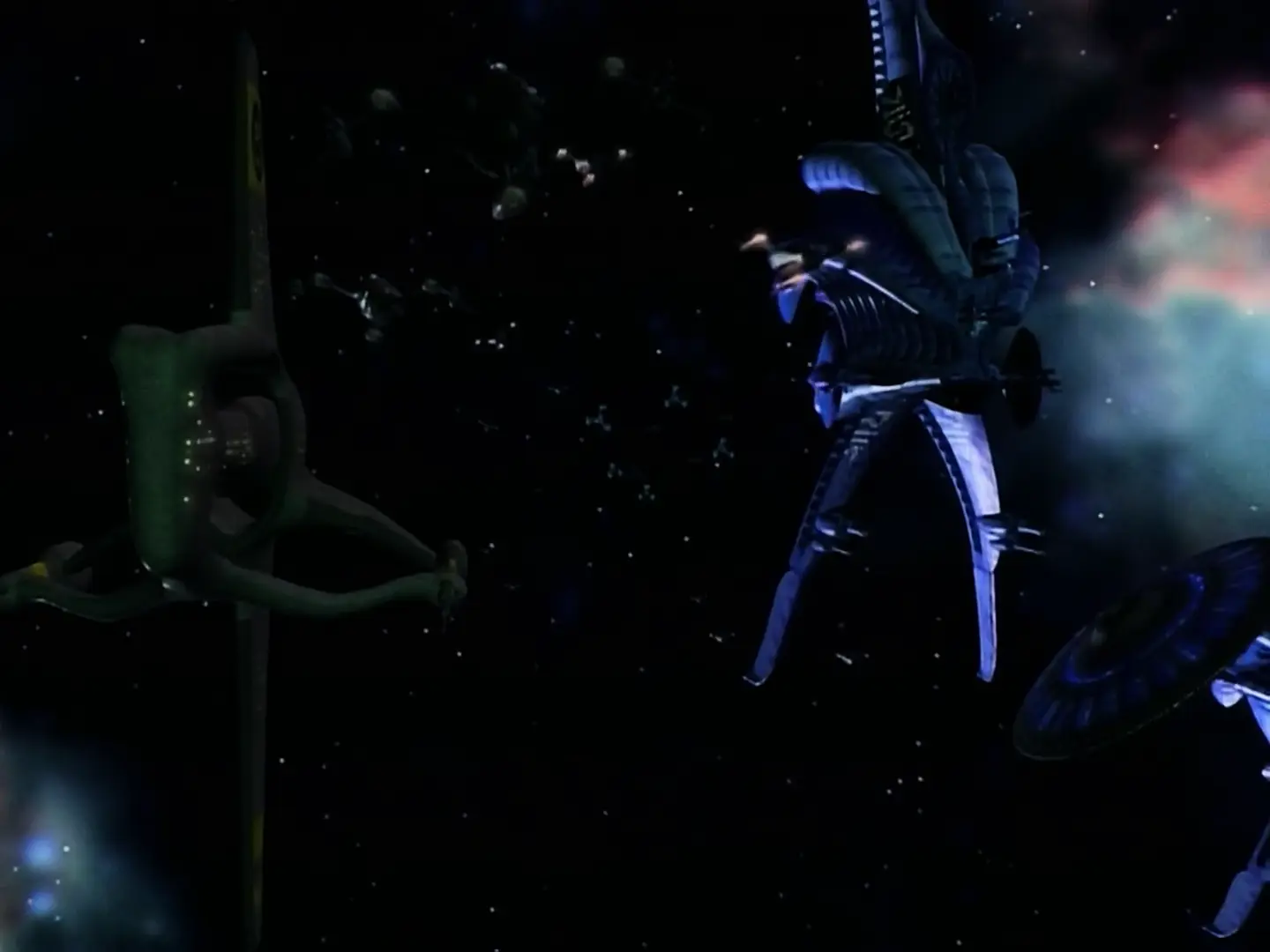
Second Shadow War Screenshot Gallery



See Also
- First Shadow War — Historical Record
- Shadow Alliance — Faction Record
- Vorlon Empire — Faction Record
- Z’ha’dum — Location Record
- White Star Fleet — Technology / Fleet Record
- Interstellar Alliance — Government Record
Sources & References
- Babylon 5 episodes: “Signs and Portents,” “In the Shadow of Z’ha’dum,” “Z’ha’dum,” “Shadow Dancing,” “Into the Fire”
- Reference sites: VEx (FrostJedi), B5Tech
- The Babylon 5 Encyclopedia (J. M. Straczynski, 2017)
- Expanded lore: Technomage Trilogy (Jeanne Cavelos); Babylon 5 RPG sourcebooks detailing Shadow War campaigns and fleet actions